How does Turnitin work for plagiarism? Turnitin compares the text in a submitted document with sources selected for the assignment, identifies identical or highly similar wording, and presents the results in a Similarity Report. Its comparison sources can include active and archived web pages, academic publications, and papers previously submitted to Turnitin.
Turnitin does not automatically decide that a student plagiarized. It finds text similarity. An instructor must then review the matched passages, sources, quotations, citations, assignment rules, and writing context to decide whether a match is acceptable or represents an academic-integrity problem.
That distinction explains the entire process: Turnitin detects matching text; people evaluate plagiarism.
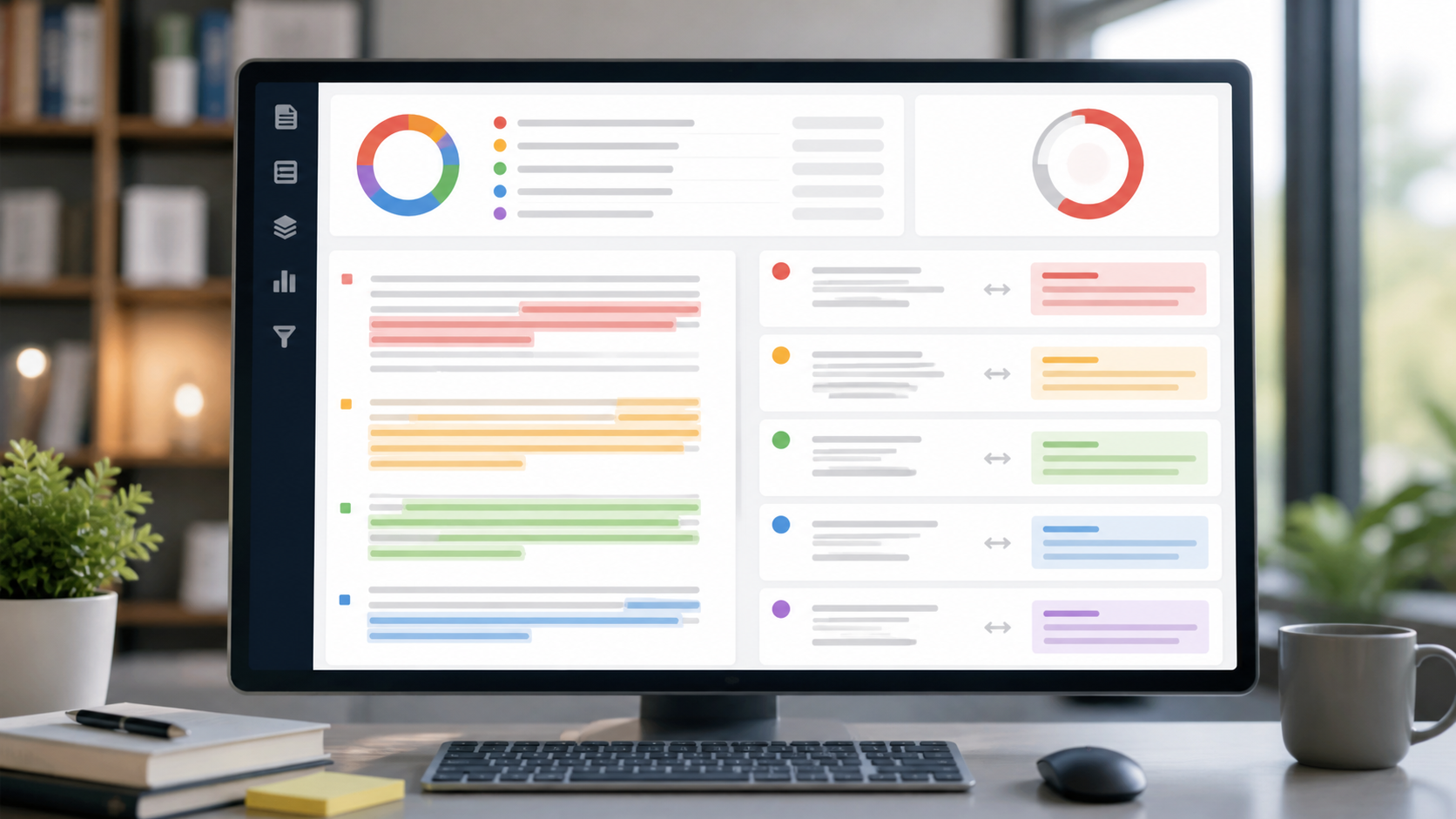
How Turnitin Works for Plagiarism: The Short Version
The Turnitin plagiarism-checking workflow can be summarized in six steps:
- A student submits a document through Turnitin or a connected learning platform.
- Turnitin extracts readable text from the file.
- The system compares that text with the databases enabled for the assignment.
- Matching or highly similar passages are connected to possible sources.
- Turnitin calculates the percentage of the document that matches those sources.
- The Similarity Report lets the student or instructor inspect each match in context.
The result is a map of textual overlap, not a misconduct verdict. A properly quoted sentence may match its original publication. A bibliography may resemble thousands of other reference lists. A submitted draft may match an earlier version of the same paper. Conversely, a low score does not prove that all source use is acceptable.
What Does Turnitin Compare a Paper Against?
The exact comparison depends on the assignment and institutional settings. Turnitin's official documentation describes several main source categories.
Active and archived internet pages
Turnitin compares submissions with billions of pages from the public internet. This can include current web pages and archived content that has changed or disappeared from its original location.
A match may therefore point to a website, article, online report, study guide, or another publicly available page. Turnitin does not need the matching page to rank prominently in a search engine for it to appear as a source.
Periodicals, journals, and publications
The comparison can include content from academic journals, periodicals, books, and other third-party publications available through Turnitin's collection. This is important because much academic source material is not freely searchable on the open web.
Previously submitted papers
Depending on repository settings, a paper may be compared with student work previously submitted to Turnitin. The comparison may include the general Turnitin repository or a private institutional repository.
This database helps identify overlap between submissions, but it can also explain unexpected matches. For example, a final paper may match a student's own earlier draft if that draft was stored in a repository. An instructor should investigate the source rather than assume that the percentage alone proves misconduct.
Sources selected for the assignment
Not every assignment necessarily uses every available database. Instructors and institutions can control which repositories are searched and whether submissions are stored for future comparisons. Two reports can therefore differ if they were generated under different settings or at different times.
How Does Turnitin Calculate the Similarity Score?
The Similarity Score represents how much of the submitted text matches sources in the databases used for the report. In Turnitin's newer report, the overall percentage is calculated from the number of matching words relative to the total word count of the document.
For example, a 20% Similarity Score means that approximately one-fifth of the document's words were included in detected matches under the report's current settings. It does not mean:
- 20% of the paper was proven to be plagiarized
- there is a 20% probability that the student cheated
- the paper deserves a particular grade or penalty
- 80% similarity-free text is automatically original
The number summarizes overlap. Its meaning depends on which words matched, why they matched, and how the sources were used.
For a detailed explanation of score ranges, see What Turnitin Score Is Too High?.
Similarity Is Not the Same as Plagiarism
Turnitin's own guidance is explicit that it checks submissions against databases and highlights similar text; it does not itself determine plagiarism.
Plagiarism is a judgment about authorship, attribution, and compliance with academic rules. The same textual match can have very different meanings in different contexts.
| Match in the report | Possible interpretation |
|---|---|
| Exact quotation with quotation marks and a citation | Legitimate source use, although excessive quotation may still be weak writing |
| Reference-list entry | Expected similarity in a standard citation format |
| Required assignment prompt or template | Shared text that may be legitimate |
| Long copied passage without quotation or citation | Serious plagiarism concern |
| Close paraphrase that follows the source's wording and structure | Possible patchwriting or inadequate paraphrasing |
| Match to the student's earlier submission | Possible self-match that requires context and instructor review |
A high score can be produced by legitimate material, and a low score can still hide a serious problem. A paper with 4% similarity could contain one uncited paragraph copied from a source. A research paper with 30% similarity could contain properly quoted evidence, a long bibliography, and a required template. The report must be opened and reviewed.
What Appears in a Turnitin Similarity Report?
A Similarity Report normally provides more than one overall number. Its purpose is to help reviewers move from the score to the actual evidence.
Highlighted matching text
Passages that match or closely resemble a source are highlighted in the submitted document. The reviewer can select a passage to see the source associated with it.
Source details
The report lists sources contributing to the similarity result and shows how much text each source matches. Reviewing the largest source matches first is often more useful than focusing on the overall percentage.
When the same passage appears in several places, Turnitin may select a top or best-match source while allowing the reviewer to inspect overlapping sources. This means the displayed source is not necessarily the first place the wording ever appeared.
Match groups
The enhanced Similarity Report can organize matches into categories based on the presence of quotation marks and in-text citations. These groups help reviewers distinguish likely citation issues from properly handled source material, but they still require human interpretation. Software cannot reliably decide every citation convention or assignment-specific exception.
Filters and exclusions
Available report settings may let an authorized user exclude bibliographic material, quoted material, small matches, particular sources, or certain source databases. Filters refine the report; they do not rewrite the submitted document.
Because exclusions change what counts toward the displayed percentage, always note the active settings before comparing two scores.
What Can Raise a Turnitin Similarity Score?
Several kinds of text can contribute to the percentage.
Direct quotations
Turnitin may correctly find the original source of quoted language. Quotation marks and citations can make the use academically acceptable, but the wording may still count as a match unless the relevant exclusion is applied.
Bibliographies and citations
References use standardized names, titles, dates, and formatting. These details naturally resemble citations in other papers. Bibliography exclusion can help a reviewer focus on the body of a paper when appropriate.
Common or required wording
Assignment questions, declarations, laboratory instructions, legal language, technical phrases, and document templates can appear across many submissions. Such matches require context.
Close paraphrasing
Replacing a few words while keeping the source's sentence structure may still create a strong match. More importantly, it may fail to demonstrate genuine understanding even if the percentage becomes lower.
Earlier drafts and reused work
A new submission can match an earlier stored version. It can also match work reused from another class. Whether reuse is allowed depends on the assignment and institution; a citation or instructor approval may be required.
Longer, research-heavy assignments
Literature reviews and research papers naturally contain more citations and source-based discussion than personal reflections. Their scores may therefore be higher without automatically indicating worse academic conduct.
What Turnitin Does Not Do
Understanding the system's limits prevents common mistakes.
It does not issue a plagiarism verdict
Turnitin surfaces evidence for review. The instructor or institution applies the relevant academic-integrity policy and makes the decision.
It does not know a writer's intent
The software cannot determine from a match alone whether a student intentionally copied, forgot a citation, misunderstood paraphrasing, followed a required template, or resubmitted an authorized draft.
It does not guarantee that unmatched writing is original
Some sources may not be in the selected databases. Ideas can be taken without copying exact language. Contract cheating and unauthorized collaboration may also produce little direct textual overlap.
It does not treat similarity and AI writing as the same thing
The Similarity Score measures source overlap. Turnitin's AI Writing Report estimates whether qualifying prose may be AI-generated or AI-altered. These are separate systems with separate percentages. Read How Does Turnitin Detect AI? for the AI-detection process.
How Instructors Review Possible Plagiarism
A responsible review goes beyond asking whether the score is high or low. An instructor may consider:
- whether a match appears in the thesis, analysis, methods, or reference list
- whether exact wording has quotation marks and a citation
- whether a paraphrase changes both wording and sentence structure
- whether one source accounts for most of the overlap
- whether the source was supplied as part of the assignment
- whether the paper matches a previous submission by the same student
- whether the work is consistent with the student's drafts and demonstrated understanding
- what the course and institution define as acceptable source use
Turnitin can make this review faster by linking text to likely sources. It cannot replace the instructor's judgment or the institution's process.
How Students Should Review a Turnitin Report
If students are allowed to view the report or resubmit, the most useful approach is source-by-source review.
- Read the assignment policy. Check the rules for quotations, collaboration, reused work, AI tools, and resubmission.
- Open the report. Do not judge the paper from the dashboard percentage alone.
- Inspect the largest matches. A single long uncited match is often more important than many short, harmless matches.
- Check exact wording. Put necessary copied language in quotation marks or a block quote and cite it correctly.
- Review paraphrases. Explain the idea from your own understanding rather than swapping synonyms into the source's structure.
- Verify citations. Cite borrowed ideas, data, interpretations, and distinctive language according to the required style.
- Identify templates and references. Do not delete required or correctly formatted material simply to force the percentage down.
- Add original analysis. Explain why the evidence matters and how it supports your argument.
- Keep drafts and notes. Version history and research notes help document the writing process.
- Resubmit only when permitted. Follow the instructor's workflow and deadline.
The objective is not a magical 0% score. The objective is transparent source use and work that genuinely reflects the student's own thinking.
Can Students Check a Paper Before Turnitin?
Access depends on the school and assignment. Some instructors let students view a Similarity Report, and some permit resubmission. Turnitin Draft Coach may also be available through an institution. Students should use only the access provided by their school and avoid uploading unpublished work to unknown plagiarism sites.
Turntin.app is an independent AI-writing review tool, not a Turnitin plagiarism checker. It can help you review whether prose contains AI-like patterns, but it cannot reproduce your school's official Similarity Score. For a step-by-step submission overview, see How to Use the Turnitin Website.
Frequently Asked Questions
Does Turnitin detect plagiarism automatically?
No. Turnitin detects matching or highly similar text and generates a Similarity Report. An instructor or institution determines whether the source use violates academic-integrity rules.
What databases does Turnitin check?
Depending on the assignment settings, it can compare a submission with active and archived internet pages, periodicals and academic publications, the general repository of submitted papers, and an institution's private repository.
Is a high Turnitin score always plagiarism?
No. Quotations, references, templates, and earlier drafts can raise the score. A high result deserves review, but it is not an automatic verdict.
Is a low Turnitin score always safe?
No. A small percentage may still represent a serious uncited passage. Some forms of unoriginal work may create little or no direct text match.
Does Turnitin compare papers with other students' work?
It can. If the relevant submitted-paper repositories are enabled, a paper may be compared with past submissions from the same institution or other institutions. Access to the underlying student paper can be restricted even when the report identifies a match.
Can citations and quotations show as matches?
Yes. Correctly cited or quoted wording can still match a source. Report filters may exclude some quoted or bibliographic material, but correct attribution remains necessary regardless of the displayed score.
What Turnitin percentage is acceptable?
There is no universal acceptable percentage. The assignment type, source distribution, citation quality, instructor rules, and institutional policy matter more than a generic cutoff.
Does Turnitin check for AI and plagiarism at the same time?
An institution may have access to both features, but they produce different results. Similarity checking looks for source overlap; AI writing detection analyzes patterns in qualifying prose. One score should not be interpreted as the other.
Final Answer
Turnitin works for plagiarism review by comparing a submission with selected databases, identifying matching or highly similar text, and calculating how much of the document appears in those matches. It presents the passages and sources in a Similarity Report so a person can evaluate quotations, citations, paraphrases, templates, and other context.
Turnitin is therefore best understood as a text-matching and investigation tool. It can provide important evidence, but the Similarity Score alone cannot prove plagiarism. The most reliable review combines the report with the assignment rules, the writer's source use, the drafting process, and informed human judgment.