Is 29% similarity on Turnitin bad? Not automatically—but 29% is high enough that you should open the Similarity Report and inspect the matches carefully.
Turnitin places a 29% Similarity Score within its 25–49% color range. That range signals a noticeable amount of matching text, not a plagiarism verdict. A score of 29% may be acceptable when most matches come from correctly quoted material, references, a required template, or an earlier draft. It may be a serious problem when the matches show uncited passages, patchwriting, or one large block copied from a source.
The fastest answer is this: 29% needs review, but the source of the 29% matters more than the number itself.
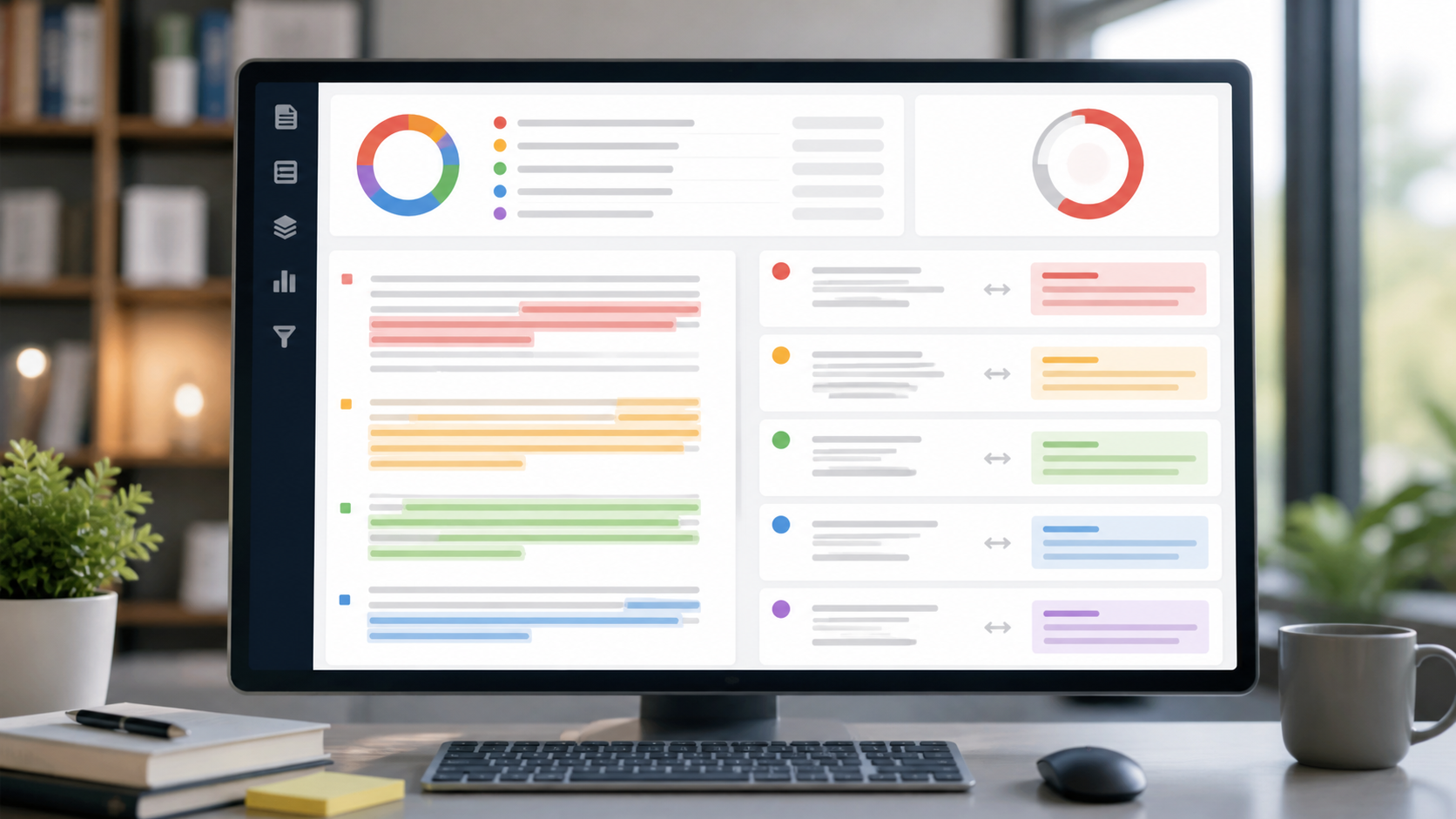
What Does 29% Similarity Mean on Turnitin?
A 29% Similarity Score means that Turnitin found text matching material in its selected databases across approximately 29% of the submitted document. Depending on the assignment settings, those databases can include:
- websites and archived internet content
- journals, books, and other publications
- previously submitted student papers
- institutional or shared repositories
The percentage measures matching text. It does not mean that Turnitin proved 29% of the paper was plagiarized, and it does not mean there is a 29% chance of misconduct.
Turnitin's official guidance states that similarity is not the same as plagiarism. The software identifies matches; an instructor reviews their context, citation, location, and relevance.
Is 29% Considered a High Turnitin Score?
Turnitin generally displays Similarity Scores in these ranges:
| Similarity score | Turnitin range | Practical response |
|---|---|---|
| 0% | No matching text | Confirm that sources and quotations are still documented properly. |
| 1–24% | Lower range | Review matches, especially any large uncited block. |
| 25–49% | Moderate-to-higher range | Inspect all major sources and matching passages carefully. |
| 50–74% | High range | Review urgently for excessive overlap, reuse, or configuration issues. |
| 75–100% | Very high range | Check for duplicate submission, templates, or extensive copied text. |
At 29%, your paper has crossed into the 25–49% range, so it deserves closer attention than a paper in the lower band. However, these colors organize results; they are not universal pass/fail rules.
Your instructor may consider 29% acceptable for a quotation-heavy research assignment but too high for a personal reflection. If the syllabus sets a maximum score, that local requirement takes priority.
When Can 29% Similarity Be Acceptable?
A 29% result can have reasonable explanations. The score is less concerning when the matched text is legitimate and handled according to the assignment's rules.
Correctly quoted and cited sources
A research paper may include direct quotations that Turnitin correctly matches to their original sources. The quotations still count toward similarity unless the report excludes them. If the wording is inside quotation marks or formatted as a block quote and cited correctly, the match may be acceptable.
Even so, too much quotation can weaken a paper. Correct citation prevents plagiarism, but it does not replace the need for your own analysis.
Bibliography and reference entries
References naturally resemble the same citations in other documents. A long bibliography can raise the score, especially if the report has not excluded bibliographic material. Check whether references account for a meaningful part of the 29%.
Required assignment language
Lab instructions, essay prompts, case-study facts, cover sheets, and institutional declarations may appear in every student's submission. These shared elements can create matches without indicating copied analysis.
A supplied template
Some assignments require fixed headings, tables, legal clauses, or report structures. If Turnitin includes that material, the overall percentage may look higher than the amount of meaningful overlap in the student's original prose.
A previously submitted draft
If an earlier version of the same work was indexed, the final paper may match it. Turnitin provides examples in which resubmitted papers receive very high scores for this reason. An instructor can investigate the earlier submission and decide whether it should be excluded.
When Is 29% Similarity a Problem?
The score becomes concerning when the report shows unattributed or excessive overlap in the parts of the paper that should reflect your own writing.
One source accounts for most of the score
Suppose the overall score is 29%, and one website contributes 21%. That pattern is more concerning than 29 one-percent matches spread across references and short, cited phrases. A large single-source match may indicate copied wording or an overly close paraphrase.
Long passages match without quotation marks
Exact language borrowed from a source normally needs quotation marks and a citation. A citation alone does not turn copied sentences into a paraphrase. If Turnitin highlights long, continuous blocks, compare them directly with the source.
The sentence structure follows the source
Changing several nouns or verbs while preserving the original sentence order and structure is often called patchwriting. It may remain too close to the source even when a citation is present.
Matches appear throughout the central argument
Overlap in the bibliography is different from overlap in the thesis, analysis, findings, or conclusion. If the paper's main reasoning repeatedly matches other documents, 29% may represent a substantial authorship problem.
Sources are missing or cited incorrectly
Turnitin does not decide whether your citation style is correct. It can show the match, but you must confirm that every borrowed idea and exact quotation has the appropriate attribution.
29% from One Source vs 29% from Many Sources
The source distribution changes how you should interpret the report.
Scenario A: One source contributes 24%
This is a strong reason to inspect the paper immediately. If most of the match is an uncited or minimally changed block, revision is necessary. If the source is an earlier version of your own submission, ask the instructor how resubmissions are handled.
Scenario B: Twenty sources contribute small amounts
This may reflect normal research writing, especially when the matches are quotations, citations, titles, and common academic phrases. Review them individually, but the distributed pattern is not the same as copying a large section from one article.
Scenario C: The bibliography contributes most of the score
The reported number may overstate meaningful overlap in the prose. Turnitin offers filters that can exclude bibliography matches, although assignment settings and instructor policy determine how the report should be viewed.
Scenario D: The assignment template contributes most of the score
Shared instructions and required headings may explain the result. Do not remove required content just to reduce the percentage. Ask your instructor whether the template should be excluded.
Is 29% Similarity Acceptable for Different Assignments?
There is no universal answer because different tasks naturally use sources differently.
Research paper or literature review
Twenty-nine percent may be understandable when the work uses many cited quotations and references. The key question is whether the student contributes enough synthesis, interpretation, and original argument.
Personal reflection
Twenty-nine percent is more unusual because reflective writing should primarily contain the student's own experiences and reasoning. Unless the assignment includes a shared prompt or template, the matches deserve close attention.
Lab report
Standard methods, technical terminology, and required formatting can create legitimate overlap. Results interpretation and discussion should still reflect the student's own work.
Legal or policy analysis
Statutory language, regulations, and formal quotations may raise similarity. Accurate quotation and citation remain essential, and the analysis surrounding that material should be original.
Thesis or dissertation
Long documents often accumulate more small matches, but institutional standards can be strict and discipline-specific. Follow the graduate school's policy and review chapter-level source patterns rather than relying on a generic internet threshold.
What Should You Do If Your Turnitin Score Is 29%?
Do not panic, and do not randomly replace words. Use the report methodically.
- Check your instructor's policy. Look for an explicit threshold and rules about quotations, bibliographies, templates, previous work, and resubmissions.
- Open the complete Similarity Report. A dashboard percentage cannot show whether the matches are legitimate.
- Sort or inspect the largest sources first. Find out whether one source drives most of the 29%.
- Review every long highlighted passage. Confirm whether exact wording has quotation marks and a citation.
- Check paraphrases against their sources. Rewrite passages that preserve too much of the original wording or structure.
- Verify all attribution. Cite borrowed ideas even when the wording is entirely your own.
- Identify references and required text. Ask whether report filters should exclude legitimate non-body matches.
- Add your own analysis. Connect evidence to your argument instead of allowing source material to dominate the paper.
- Preserve drafts and notes. Keep evidence of your writing and research process.
- Recheck only if resubmission is permitted. Follow the assignment rules rather than assuming you can upload repeatedly.
The goal is not to force the score below an arbitrary number. The goal is to ensure that every match is legitimate, transparent, and academically appropriate.
How to Lower a Problematic 29% Score Ethically
If the report reveals genuine problems, revise the writing—not the detector.
- Remove quotations that do not add value.
- Quote exact wording clearly and cite it.
- Paraphrase by explaining the source from your own understanding and structure.
- Add analysis after evidence instead of stacking quotations.
- Cite every borrowed claim, statistic, theory, or interpretation.
- Ask the instructor about accidental self-matches or earlier drafts.
- Keep required templates intact unless told otherwise.
Avoid synonym swapping, invisible characters, character substitution, and “plagiarism remover” tactics. These methods do not demonstrate understanding and may create additional integrity concerns.
For a broader breakdown of every range, read What Turnitin Score Is Too High?.
Does 29% Similarity Mean 29% AI?
No. Turnitin similarity and Turnitin AI detection are separate systems.
The Similarity Score measures matching text found in databases. The AI Writing Score estimates how much qualifying prose may resemble AI-generated or AI-altered writing. A paper can receive 29% similarity and 0% AI detection, or low similarity and a much higher AI score.
Do not use advice about similarity ranges to interpret an AI Writing Report. If you need to understand AI detection, see How Does Turnitin Detect AI?.
Check AI-Writing Risk Free with Turntin.app
After resolving citation and similarity issues, you can use Turntin.app to review a different risk: whether your prose contains patterns commonly associated with AI-generated writing.
Turntin.app provides a free, accurate, and practical AI-writing check for students and writers. It does not reproduce your school's official Turnitin Similarity Score, and no independent detector can guarantee the same result as an institutional system. Instead, it gives you useful pre-submission feedback so you can review generic or overly uniform passages and strengthen them with your own evidence, analysis, and voice.
Turntin.app is built around data safety. Submitted text is processed only to return the requested analysis, discarded after processing, not used to train machine-learning models, and not sold or shared with third parties. See our Privacy Policy for details.
Turntin.app is independent and is not affiliated with or endorsed by Turnitin. Start with the free detector at Turntin.app. For an unrestricted Pro experience designed for longer and repeated workflows, visit AceEssay Pro.
Frequently Asked Questions
Is 29% similarity too high for a college essay?
It may be. Twenty-nine percent requires careful review, especially if matches appear in the essay's main argument. It may be acceptable when the overlap comes from properly quoted evidence, references, or required material and complies with the instructor's policy.
Will I fail with 29% similarity?
Turnitin does not assign your grade, and 29% does not automatically mean failure. Your instructor evaluates the report under the course's academic-integrity and citation policies.
Does 29% mean I plagiarized?
No. It means Turnitin found matching text in about 29% of the submitted document under the current settings. Whether any match is plagiarism depends on quotation, citation, authorship, context, and institutional policy.
Can references cause a 29% Turnitin score?
Yes. A long bibliography and repeated citation formats can add to similarity when they are included in the report. Inspect the highlighted sections and ask whether the relevant filter should be applied.
Should I remove citations to lower 29% similarity?
No. Removing citations makes the paper less transparent and can create plagiarism concerns. Keep necessary attribution and focus on excessive quotation, close paraphrasing, and missing original analysis.
Is 29% similarity the same as a 29% AI score?
No. Similarity measures text overlap with database sources. AI detection evaluates patterns in qualifying prose. The two scores are independent.
Final Answer
A 29% Turnitin Similarity Score is not automatically bad, but it is high enough to require a source-by-source review. It falls within Turnitin's 25–49% range, where the amount of matching text is noticeable. Whether it is acceptable depends on your instructor's threshold, the assignment type, the location of the matches, and whether borrowed material is quoted and cited correctly.
Focus on why the score is 29%, not merely on making the number smaller. A transparent, well-cited research paper can legitimately show similarity; a lower-scoring paper can still contain an uncited copied passage.