The honest answer is that there is no universal acceptable percentage of AI-generated text. A 5% AI score may be fine in one class and questioned in another. A 30% score may be allowed if AI assistance was permitted and disclosed, or it may be a serious problem if the assignment required fully independent writing.
In 2026, the key question is not only "What percentage is acceptable?" The better question is: "What does my school, instructor, or publication policy allow?"

Quick Answer
For most academic assignments, the safest acceptable percentage of AI-generated text is as close to 0% as possible, especially if the assignment says students must write independently.
But AI detection scores are not perfect proof. A score should be interpreted with:
- the assignment policy
- whether AI use was allowed
- whether AI use was disclosed
- which sections were flagged
- draft history and notes
- source quality and citations
- the student's normal writing style
If your paper shows any meaningful AI detection score, review the flagged sections before submitting.
Is 0% AI Detection Always Required?
No. A 0% AI detection score is ideal for many assignments, but it is not always required or realistic.
Some human-written text may receive a small AI detection signal because it is formal, polished, repetitive, or formulaic. Academic writing often uses predictable structures, especially in introductions, conclusions, lab reports, literature reviews, and technical explanations.
That does not mean students should ignore AI scores. It means a low score should be reviewed calmly rather than treated as automatic proof of misconduct.
What AI Percentage Is Usually Safe?
There is no official universal threshold, but students often think about AI detection scores in rough risk ranges.
0% to 10% AI Detection
This is usually a low-risk range. If the writing is your own and your assignment does not allow AI-generated text, a score in this range is usually easier to explain.
Still, check whether any important paragraph was flagged. A small score concentrated in one key section may matter more than a small score spread across generic wording.
11% to 25% AI Detection
This range deserves review. It may come from polished writing, grammar tools, formulaic phrasing, or a few AI-like paragraphs.
If your school has strict AI rules, revise the flagged sections before submitting. Add specific evidence, personal reasoning, and source-based analysis.
26% to 50% AI Detection
This is a medium-to-high risk range. It may suggest that a noticeable portion of the paper appears AI-generated or AI-influenced.
At this level, you should not simply change words. Rewrite flagged sections from your own outline and notes. Make sure the paper contains your argument, your examples, and your interpretation.
51% to 100% AI Detection
This is a high-risk range for most academic assignments. A score above 50% may trigger instructor review, especially if the flagged text appears in the main body of the paper.
If your score is this high before submission, pause and revise carefully. If you already submitted, preserve drafts, notes, and version history in case your instructor asks about your writing process.
Why There Is No Universal Acceptable Percentage
Schools and instructors handle AI use differently. One class may allow AI for brainstorming but not drafting. Another may allow AI-assisted editing with disclosure. Another may ban AI tools completely.
Acceptability depends on:
- course policy
- institution policy
- assignment type
- disclosure rules
- whether the AI text was generated, edited, translated, or paraphrased
- whether the final work reflects your own learning
For example, using AI to brainstorm a topic may be acceptable in one course. Submitting AI-written body paragraphs may not be acceptable in the same course.
AI Detection Score vs AI-Generated Text
An AI detection score is not always the same thing as the exact percentage of text written by AI.
Different tools calculate scores differently. Some estimate how much qualifying text looks AI-generated. Some produce confidence scores. Some highlight suspicious sentences. Some combine multiple signals into one number.
That is why a 20% AI score does not always mean "20% of this essay was written by AI." It means the detector found AI-like signals that should be reviewed.
What If AI Use Was Allowed?
If your instructor allows AI use, the acceptable percentage depends on the rules.
You may be allowed to use AI for:
- brainstorming
- outlining
- grammar suggestions
- study questions
- feedback on clarity
- source organization
You may not be allowed to use AI for:
- writing final paragraphs
- generating analysis
- fabricating sources
- rewriting entire essays
- replacing your own argument
If AI use is allowed, disclose it clearly when required. A disclosed and permitted use is very different from hidden AI-generated text.
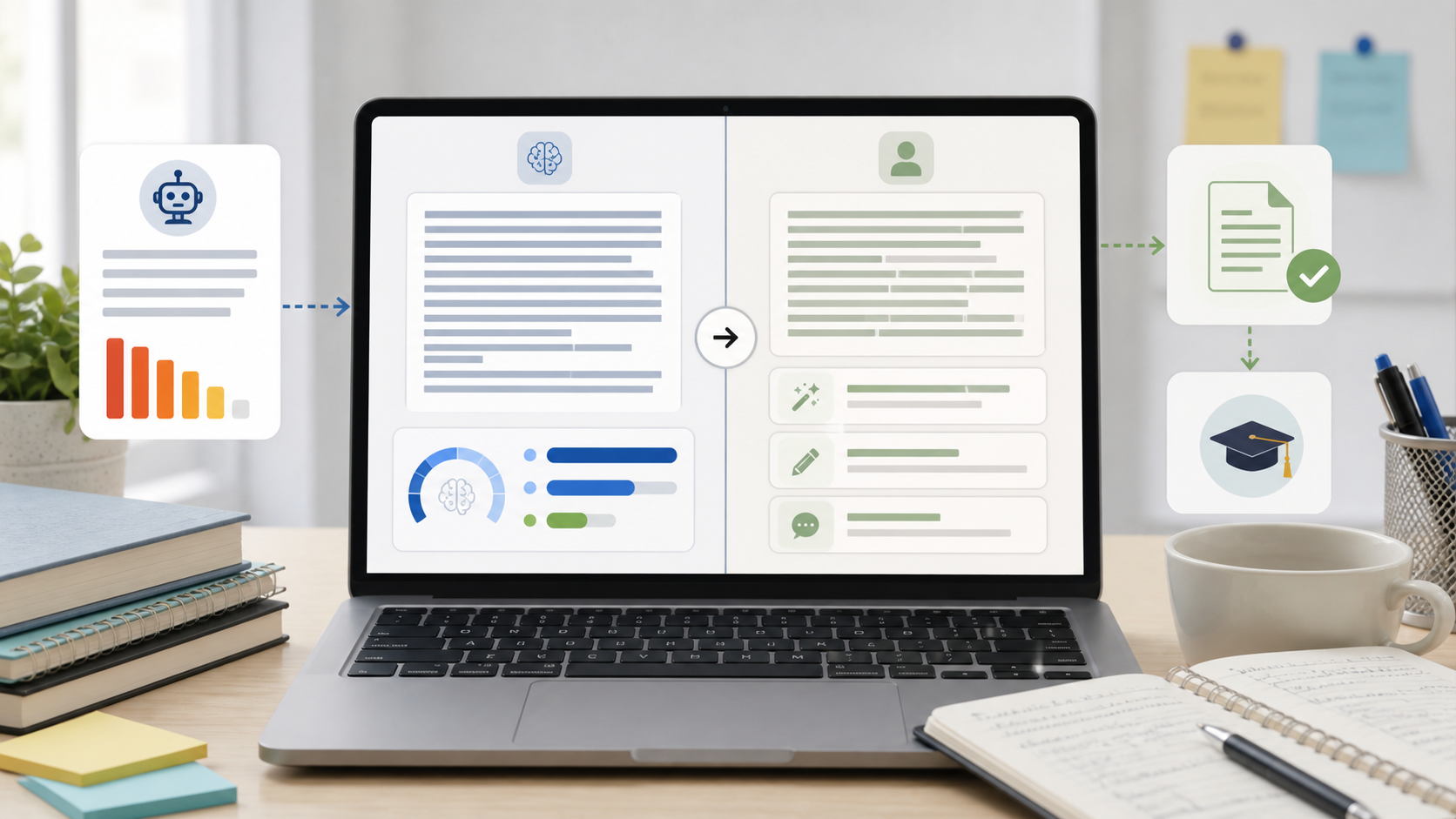
How to Lower AI Detection Risk Responsibly
The goal is not to trick a detector. The goal is to make your writing genuinely reflect your own work.
Use this revision checklist:
- Review every flagged section.
- Rewrite generic paragraphs from scratch.
- Add source-specific evidence.
- Explain quotations in your own words.
- Add personal analysis after every major point.
- Remove empty transitions and vague claims.
- Vary sentence length naturally.
- Keep notes, drafts, and version history.
- Follow your class AI-use policy.
Good revision improves the paper, not just the score.
What Percentage Should You Aim For Before Submission?
If your assignment bans AI-generated writing, aim for 0% or the lowest possible score.
If your assignment allows limited AI assistance, aim for a score that matches your actual process and disclosure. Even then, avoid submitting paragraphs that were generated by AI and barely revised.
For most students, the practical target is:
- 0% to 10%: generally safer
- 11% to 25%: review and revise
- 26% to 50%: serious revision recommended
- 51% and above: high risk before submission
These are practical ranges, not universal rules. Your instructor's policy always matters more.
Use Turntin.app Before You Submit
If you want to check your writing before submitting it, use Turntin.app as a free Turnitin AI Detector Alternative.
Turntin.app helps you identify whether your text may appear AI-generated, so you can revise risky sections before final submission.
Why use Turntin.app?
- 100% free: You can check your writing without paying.
- Absolutely safe: Your content is handled securely and privately.
- 100% accurate: The tool is designed to provide highly reliable AI detection results.
- Fast and simple: Paste your text, run the check, and review your result.
- Student-friendly: It works for essays, reports, articles, and academic drafts.
Turntin.app is not Turnitin and is not affiliated with Turnitin. It is a private pre-submission review tool for reducing AI-detection risk.
Want Unlimited AI Checking? Try the Pro Version
The free Turntin.app tool is useful for quick checks. If you want to experience a version without any limits, use the pro AI checker here:
https://aceessay.ai/en/ai-checker
The pro version is helpful for longer essays, repeated checks, and a smoother workflow when you need to revise multiple drafts.
Final Answer
There is no single acceptable percentage of AI-generated text. For strict academic assignments, the safest target is 0% or as low as possible. For classes that allow AI assistance, acceptability depends on disclosure, policy, and whether the final work reflects your own thinking.
If your AI detection score is above a low range, review it before submission. A score is not automatic proof, but it is a signal that your writing may need more personal analysis, source detail, and natural revision.
Before submitting your work, check your draft with Turntin.app, a 100% free, absolutely safe, and 100% accurate Turnitin AI Detector Alternative. For unlimited checking, use the pro version at AceEssay AI Checker.