People often ask why Turnitin is not reliable after seeing a surprising Similarity Score or an AI Writing Report that does not match the writer's actual process. The balanced answer is that Turnitin can be useful, but its reports are screening signals—not automatic proof of plagiarism or AI use.
Turnitin performs two different kinds of analysis. Its Similarity Report finds text that matches material in selected databases. Its AI Writing Report estimates whether qualifying prose resembles AI-generated or AI-altered writing. Neither system can independently understand a student's intent, verify the full writing process, or make a fair academic-integrity decision without context.
That does not make Turnitin useless. It means the software is reliable for some tasks and limited for others. Problems occur when a percentage is treated as a verdict instead of the beginning of a review.
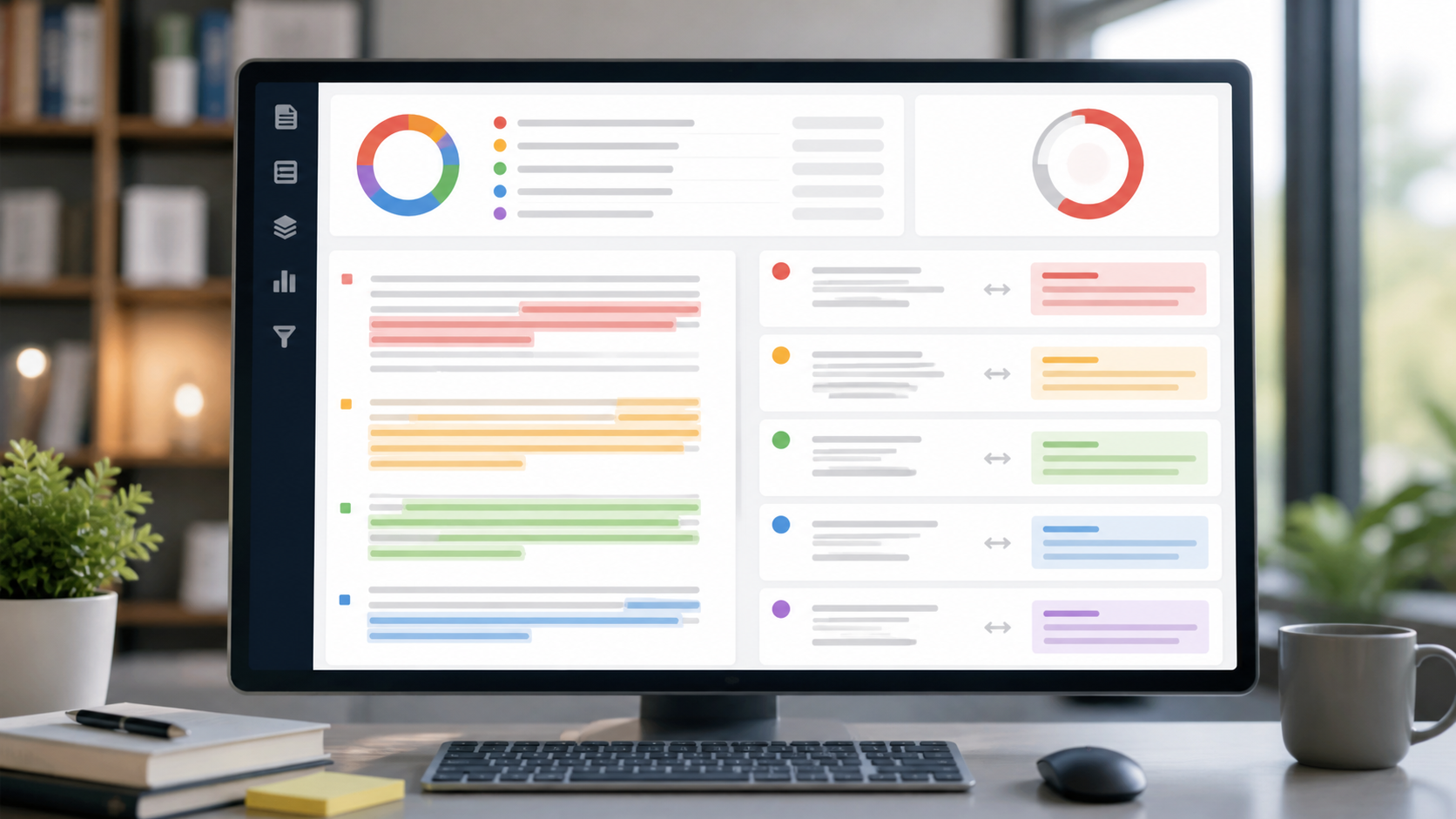
Is Turnitin Reliable?
Turnitin is generally useful for locating matching text and flagging passages for further review. It can help instructors find source overlap across web pages, publications, and repositories of submitted work. Its AI detector can also identify language patterns that its model associates with generated writing.
But “reliable” depends on the claim being made:
- Can Turnitin find many textual matches? Yes.
- Can a Similarity Score prove plagiarism? No.
- Can Turnitin flag writing that resembles AI output? Yes.
- Can an AI score prove who wrote the paper? No.
- Can the same paper receive different results under different settings or model versions? Yes.
- Should an instructor use the report as one source of evidence? Yes.
- Should the report be the only basis for a penalty? No.
Turnitin's own documentation reflects these limits. It states that the Similarity Report does not determine plagiarism and that its AI writing model can misidentify human-written, AI-generated, and AI-paraphrased text.
1. Similarity Is Not the Same as Plagiarism
The biggest reliability problem is often not the matching technology—it is the interpretation of the result.
A Similarity Score measures how much text matches content found in Turnitin's selected databases. Matching text can come from:
- correctly quoted sources
- bibliography entries
- common academic phrases
- required assignment wording
- institutional templates
- the student's own earlier submission
- uncited or copied material
The percentage does not distinguish all of those situations by itself. A 25% score made up of properly cited quotations is different from a 9% score caused by one uncited copied paragraph. Yet the dashboard number alone can make the first paper look more suspicious.
Turnitin explicitly says it checks for similarity, not plagiarism. Plagiarism requires a judgment about attribution, authorship, intent, and academic rules—questions that software cannot settle from textual overlap alone.
2. A High Score Can Have Innocent Causes
Turnitin can accurately detect a match while the overall impression created by the score is misleading.
For example, a high percentage can result from:
- a quotation-heavy literature review
- a long reference list
- repeated technical or legal language
- a laboratory report using standard methods
- a paper built on a required template
- a final draft matching an indexed first draft
- a shared assignment prompt included in the file
These are real matches, but they do not all represent misconduct. The instructor must open the report, examine the sources, and decide which overlap is expected or properly attributed.
This is why there is no universal “safe” Turnitin percentage. The acceptable amount depends on the assignment, discipline, source requirements, and institutional policy. See What Turnitin Score Is Too High? for a complete range-by-range guide.
3. A Low Score Can Miss a Serious Problem
The reverse is also true: a low score does not prove that a paper is original or properly written.
A document may have a low Similarity Score while containing:
- one short but important uncited passage
- an idea taken from a source without textual copying
- inaccurate or fabricated citations
- extensive paraphrasing that no longer matches the original wording
- translated source use that is not identified by the active comparison settings
- AI-generated prose that does not overlap with stored sources
Similarity matching is strongest when wording overlaps with accessible material. It is not a complete authorship, factual accuracy, or citation-quality audit.
This limitation matters because users sometimes treat 0% as proof of originality. In reality, 0% means the selected databases and settings did not produce reportable text matches. It does not validate every idea or establish who wrote the paper.
4. Filters and Assignment Settings Change the Score
Turnitin reports are configurable. Instructors can apply settings that exclude or include:
- bibliography and reference sections
- quoted material
- cited text in supported report versions
- matches below a chosen word or percentage threshold
- assignment template content
- particular sources or repositories
Those choices can materially change the displayed Similarity Score without changing one word of the student's paper.
Students may also be able to apply temporary exclusions while viewing a report, but Turnitin notes that those changes do not necessarily alter the official score seen by the instructor. Two people can therefore look at different report views and believe they are discussing the same number.
Settings are useful because they reduce noise. They also show why a raw percentage is not a universal, context-free measurement.
5. Resubmissions Can Create Self-Matches
A paper may match an earlier version of itself if the earlier submission was stored in a repository. Turnitin's own guidance includes a scenario in which a resubmitted draft produces a 100% Similarity Score.
That does not mean the final draft was copied from another student. It means the system found matching text in a prior indexed submission. An instructor may need to identify and exclude the earlier version where policy permits.
Repository settings and report-generation timing can also affect results. Turnitin explains that some assignments regenerate reports at the due date and compare submissions against one another, which can cause scores to change. A percentage is therefore partly a product of when and how the assignment was configured.
6. The Source Database Is Large, Not Omniscient
Turnitin compares papers against extensive collections of web content, publications, and submitted work. No comparison database, however, represents every book, private document, paywalled archive, unpublished manuscript, translated passage, or conversation.
If a source is absent or its wording has been transformed substantially, a direct similarity system may not surface it as expected. Conversely, common wording can match even when no copying occurred.
This is a structural limitation of similarity detection: it can report what it finds in the comparison environment, but it cannot prove that unmatched material is original.
7. AI Detection Is Probabilistic, Not Direct Evidence
Turnitin's AI Writing Report does not observe a student using ChatGPT, Gemini, Claude, or another tool. It analyzes the submitted prose and estimates whether language patterns resemble writing produced or altered by AI.
Turnitin describes a process in which qualifying prose is divided into overlapping segments, classified, and combined into sentence- and document-level results. That is a probabilistic inference. The model does not retrieve an authorship certificate from a chatbot.
As a result, two types of error are possible:
- False positive: human writing is classified as likely AI-generated.
- False negative: AI-generated or AI-assisted writing is classified as human.
Turnitin states that its model may misidentify human, AI-generated, and AI-paraphrased text. It also instructs users not to treat an AI report as the sole basis for adverse action against a student.
For more detail on the mechanism, read How Does Turnitin Detect AI?.
8. Human Academic Writing Can Resemble AI Text
AI detectors learn statistical differences from examples, but human writing is highly varied. Some legitimate academic prose can be regular, predictable, and formulaic because the assignment or discipline demands it.
Potentially difficult cases include:
- laboratory methods
- policy summaries
- technical definitions
- structured exam responses
- highly edited academic prose
- repetitive assignment formats
- short or generic explanatory passages
None of these automatically causes a false positive, and a flagged passage is not necessarily innocent. The point is that writing patterns alone cannot establish intent or authorship with certainty.
A fair review should compare the report with earlier drafts, research notes, version history, source use, prior writing samples, and the student's explanation.
9. Short and Non-Prose Text Has Detection Limits
Turnitin's current guidance defines qualifying text as prose sentences in long-form writing, such as essays, dissertations, and articles. It says the AI model does not reliably detect several other formats, including poetry, scripts, code, bullet points, tables, and annotated bibliographies.
The file also needs enough qualifying prose to generate an AI report. This means a displayed AI percentage may describe only the eligible prose—not every word, table, quotation, reference, or formatting element in the submission.
If users assume the percentage represents the entire file, they may misread what the system actually evaluated.
10. Low AI Scores Are Less Certain
Turnitin currently suppresses exact AI percentages between 1% and 19%, displaying *% instead. The company explains that false positives occur more often in this low range, so it does not show precise scores or highlights there.
This design choice is an acknowledgment of uncertainty. The *% indicator does not prove AI use, and it is not equivalent to 0%. It means the result fell into a range Turnitin considers less reliable for precise reporting.
Even results at or above 20% still require human review. The threshold controls how the report is displayed; it is not a universal academic-misconduct boundary.
11. Model Updates Can Change Results
Generative AI systems evolve, and detection models are updated in response. Turnitin's product documentation notes that updated AI models can produce different scores when older papers are resubmitted and analyzed again.
That does not automatically mean the newer or older report is “wrong.” It means the measurement depends on the model version, supported language, text, and decision thresholds active at the time of processing.
This is another reason a percentage should not be treated like an immutable forensic fact. It is the output of a particular model at a particular time.
12. Turnitin Cannot See the Full Writing Process
A submitted file is the end product. It does not necessarily reveal how the work developed.
Turnitin may not know from the final prose alone whether a student:
- built an original outline
- took detailed research notes
- drafted the paper over several weeks
- received permitted feedback
- used grammar suggestions
- disclosed allowed AI assistance
- pasted text from an unauthorized source
Some Turnitin products provide additional writing-process information, but access and capabilities vary by institution and workflow. In a standard report, the instructor still needs external context.
Version history, drafts, notes, citation records, and a conversation with the writer can provide evidence the final percentage cannot.
Similarity Report vs AI Writing Report
The two reports should never be treated as interchangeable:
| Report | What it measures | What it cannot prove |
|---|---|---|
| Similarity Report | Text matching selected databases | Plagiarism, intent, or authorship |
| AI Writing Report | Patterns associated with AI-generated or AI-altered qualifying prose | Which tool was used, who wrote the passage, or misconduct |
A paper can have high similarity but low AI detection, or low similarity but high AI detection. Adding the two percentages together is meaningless because they measure different properties.
How Instructors Should Use Turnitin Responsibly
Turnitin becomes more reliable as part of a careful review process:
- Inspect the highlighted passages and largest sources.
- Apply appropriate quotation, bibliography, template, and small-match settings.
- Separate acceptable source use from uncited copying.
- Treat AI scores as signals rather than proof.
- Compare the work with previous writing and assignment expectations.
- Ask for drafts, notes, and version history when authorship is questioned.
- Give the student an opportunity to explain the writing process.
- Follow the institution's published academic-integrity procedure.
The instructor—not the percentage—must make the contextual judgment.
What Students Should Do with a Questionable Result
If a Turnitin result appears wrong, preserve evidence before making major changes:
- save the exact submitted file
- download or capture the available report
- keep outlines, notes, and research records
- preserve document version history
- identify which passages and sources were flagged
- read the course AI and citation policy
- ask the instructor for a source-by-source or passage-level review
Do not delete drafts or immediately rewrite everything. Those records may be your strongest evidence that the paper developed through genuine work.
If the issue is an AI flag, see Can Turnitin Be Wrong? and our Turnitin False Positive Guide.
Use Turntin.app for a Private Pre-Submission AI Check
Students often cannot see an institutional AI Writing Report until after submission. Turntin.app offers a free, accurate, and practical way to review AI-writing risk before that point.
Turntin.app analyzes writing for AI-like patterns and highlights material that may deserve closer review. It should be used to improve honest work—not to hide prohibited AI use. Like every responsible detector, it provides an estimate rather than guaranteed proof or a promise that another platform will return the same score.
The service is designed around data safety:
- submitted text is processed only to provide the requested analysis
- text is discarded after processing
- submissions are not used to train machine-learning models
- writing is not sold or shared with third parties
Review the details in our Privacy Policy. Turntin.app is independent and is not affiliated with or endorsed by Turnitin.
Start with the free checker at Turntin.app. If you want an unrestricted Pro experience for longer documents and repeated checks, visit AceEssay Pro.
Frequently Asked Questions
Why is Turnitin not 100% reliable?
Similarity reports cannot judge intent or citation context, while AI reports make probabilistic classifications from writing patterns. Report settings, repository coverage, resubmissions, text type, and model updates can also affect results.
Can Turnitin falsely accuse someone of plagiarism?
Turnitin produces matches and similarity percentages; it does not itself determine plagiarism. A false accusation can occur when a person misinterprets legitimate matches as misconduct without reviewing quotations, citations, templates, references, or previous submissions.
Can Turnitin AI detection be wrong?
Yes. Turnitin says its model can misidentify human-written, AI-generated, and AI-paraphrased text. Both false positives and false negatives are possible, so the report requires supporting evidence and human judgment.
Does a 0% similarity score prove original writing?
No. It means the active comparison did not find reportable matching text. It does not verify authorship, factual accuracy, proper use of every idea, or the absence of AI assistance.
Why did my Turnitin score change?
The score can change because of filters, excluded sources, repository indexing, due-date report regeneration, resubmission, or updated AI detection models. Ask which report type and settings were used.
Is Turnitin useless if it can be wrong?
No. It is useful for locating text matches and identifying passages for review. The problem is treating its output as a final verdict rather than evidence that needs interpretation.
Is Turntin.app more reliable than Turnitin?
The tools should not be presented as identical. Turntin.app provides private pre-submission AI-pattern feedback, while Turnitin offers institution-managed similarity and AI reports. Turntin.app is useful for an additional review, but no detector should be treated as infallible.
Final Answer: Why Turnitin Is Not Always Reliable
Turnitin is not always reliable as a final judge because it cannot determine plagiarism or authorship from a percentage alone. Similarity results can be affected by citations, templates, settings, databases, and earlier submissions. AI results are probabilistic and can produce false positives or false negatives, especially when users ignore text eligibility and reporting thresholds.
Turnitin is most useful as a screening tool. A fair conclusion requires the report, the assignment policy, source context, writing-process evidence, and human judgment.